
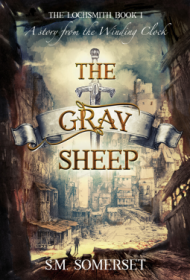
In The Gray Sheep, S.M. Somerset offers an intricately imagined world that expands the standard boundaries of the fantasy genre.
The action takes place in Marenburg, a coastal city bearing, simultaneously, marks of a medieval port, ancient market mecca and thriving capital in the throes of an industrial revolution. The book opens six months after warships have arrived in Marenburg waters from the island of Tearn, laying siege to the city, and follows Cosette, a 26-year-old who manages her father’s jewelry shop following his illness.
Cosette has been struggling to make ends meet as the invading Tearnan forces fight for access to the city, trade dries up, and tensions in Marenburg’s artisan district rise (the title is a derogatory term for the city’s Tearnan locals). When riots break out and Cosette’s shop is caught in the destruction, she is soon drawn into the battle for control of the city.
Separated from her ailing father, she attempts to find him by crossing the war-ravaged city, and when she falls into the hands of the Tearnans, she must re-examine her loyalties to stay alive and keep her family safe.
Somerset calls her imagined world an “anachronistic setting undergoing an industrial revolution.” Her commitment to this unique form of fantasy world-building is impressive. The text offers exhaustive footnotes and maps and extensive dives into this world’s history, which add depth to Cosette’s struggles.
The name Cosette doesn’t seem coincidental. Somerset’s fantasy echoes Victor Hugo’s Les Miserables as much as it does contemporary tales of magic and monsters. The novel takes its time, but the author’s world-building gives weight to its characters and conflicts, and Cosette’s struggles offer a highly detailed and personal view into a political conflict that’s at once modern and medieval.
For those willing to immerse themselves in the story’s particulars, the payoff is a richly drawn character study offering commentary about contemporary politics, with subtle magic, folklore and action thrown in for good measure.