
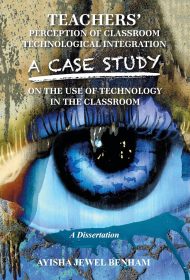
As today’s educators increasingly use technology to enhance classroom instruction and student engagement, Ayisha Jewel Benham’s dissertation explores how public school teachers perceive the effectiveness of integrating Information, Communication, and Technology (ICT) into their educational approaches.
Benham’s Case Study Research asks teachers employing web-based tools to what degree they witnessed ICT contributing to student motivation and development of creative and Higher Order Thinking Skills (HOTS). She also investigates teacher perceptions of whether they received adequate ICT training to assist student learning and HOTS, particularly given the “barriers and challenges” of utilizing ICT during pandemic years.
Using a qualitative (anecdotal) research methodology versus a quantitative (data-driven) approach, Benham carried out classroom observations and personal interviews with a meager sample population: approximately ten highly qualified teachers from public schools in two Silicon Valley, California districts. Surveys, interview forms, and questionnaires (included in the dissertation’s appendix) feature several “open-ended” questions.
Benham’s observations borrow methodology from Babbie (1995) and Mahwasane (2019) who gathered data before the pandemic, concluding there’s a need “to implement a more rigorous technological education program with teacher buy-in” and a “comfort level” for experimentation when using ICT tools. Benham’s interviews mirror these older studies, adding little insight.
Missing from Benham’s work are examples with feedback on the success or failure of ICT in specific classroom lessons. Her conclusions are general, at times vague and incomplete. Her research would benefit from describing teachers’ perceptions based on concrete, measurable student outcomes, rather than anecdotal evidence: What were the teachers’ criteria for their perceptions? How exactly did web-based learning activities “inspire” student engagement or the application of HOTS? Most importantly, what does HOTS look like in the ICT classroom? Including such data would strengthen Benham’s analysis.
As is, Benham spends more time explaining her research design than reaching original insights. Given how rapidly ICT and AI are evolving, the implications and requirements for classroom integration are staggering. This offering, however, does little to advance the conversation.
Also available as an ebook.