
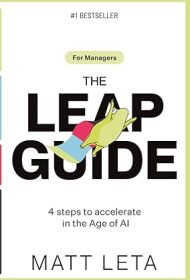
From electric cars to AI, innovation is the stick that stirs the market. In this book, consultant Matt Leta offers businesses a guide on how to become innovative on a consistent basis.
Leta describes his LEAP framework, an acronym that stands for Locate, Evaluate, Action plan, and Progress. In the LEAP approach, small multi-disciplinary teams identify opportunities for innovation, evaluate them and narrow down the list, create a plan for their implementation, and develop a prototype to indicate the direction of the proposed innovation. These opportunities might include process, product or market innovation. Through repeating the LEAP cycle, and by scaling the practice to include wider circles of the organization, companies can generate a permanent culture of innovation.
The author goes into detail, often tedious, about the LEAP process and includes QR codes where readers can download even more templates and artifacts. Much of the prose reads like a textbook, complete with sample meeting agendas and ready-made matrices and diagrams for the LEAP meetings. The author is optimistic about AI as a tool for innovation, rejecting skepticism about it from many quarters, not least from digital consumers and creators.
Unfortunately, the author wastes a great deal of space in the text telling readers what he’s going to convey and in which chapter it will appear, rather than just conveying it. He also requests Amazon reviews in the body of the text twice. It might be appropriate to solicit reviews on a dedicated marketing page or an “About the Author” section, but reading that request in the main text is off-putting.
Leta’s LEAP framework is derivative of popular business approaches such as Design Thinking, Agile, and The Lean Startup. As such, his book is itself a case of incremental innovation. These ideas are not new; rather, Leta presents a synthesis of solid concepts about how companies can become more innovative.
Practical, if unexciting, his guide can be useful for managers seeking a refresher on innovation.
Also available in hardcover and ebook.